 |
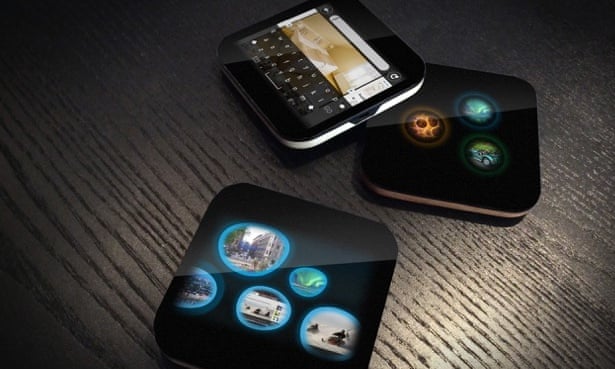
| Solu is four inches wide and has an edge-to-edge touchscreen, but it’s not intended to be a mobile phone replacement. |
Three aggressive architects from Finland are offering to change individualized computing with another convenient PC and working framework
PCs, says business person Kristoffer Lawson, haven't changed much in 20 years. It's as yet a container, a screen and, in case you're utilizing a desktop, a console.
However, Lawson believes that the time of distributed computing merits its own sort of figuring gadget. Compact, yet more intense than a portable, intended to be connected to any desktop screen and with another sort of working framework that associates all the more smoothly to your contacts. Furthermore, at a dispatch in San Francisco on 15 October, that is the thing that Lawson and whatever remains of the Solu group divulged.
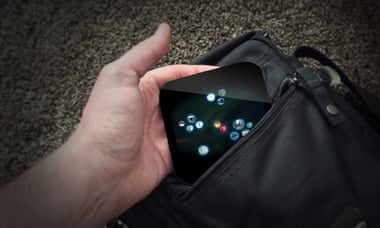 |
| Solu is sold through Kickstarter for €349. |
Solu may resemble a beverages liner yet don't put your espresso on it; this is a four-inch wide square of bended, wood-encased PC with an edge-to-edge touch screen. Inside is a capable 2.3GHz processor, battery and Wi-Fi capacity. It can be utilized all alone or combined with a console and a show up to a determination of 4K. At the point when matched along these lines, the Solu goes about as an info gadget rather than a mouse.
"This is something I've been considering for a long time, however in those days the innovation that would have enabled us to do this would have been so intricate and costly – especially the equipment – that it would have been outlandish," says Lawson in a muddling Belfast-Finnish intonation.
He depicts Solu as "the littlest universally useful PC at any point made". At around 10cm squared with a thickness of 12mm it is without a doubt little – more like a cell phone than a PC, yet with handling punch.
Lawson has been chipping away at Solu's equipment and working framework throughout the previous 12 months, with a group that incorporates the previous Nordic executive of TMF Group Javier Reyes and Pekka Nikander, who established IT security consultancy Nixu.
The group was, says Lawson, pulled in to the jumping desire of the Solu venture: to disturb the individualized computing foundation. "At the point when the test is sufficiently huge, the shrewd individuals will get roused."
Lawson draws specifically on experience building Holvi, a straightforward web based keeping money and bookkeeping administration. Like keeping money, individualized computing is a market that has been overwhelmed by significant players like Microsoft and Apple for quite a long time. The portable insurgency has given us figuring power moving, yet the desktop staple – especially the UI – has stayed unaltered.
Lawson's greatest fuss with today's PCs is "the way gravely they utilize the web as a major aspect of their entire experience".
"Yes we have email yet despite everything we're battling with reinforcements, hard drive space and downloading and introducing applications," he says. "The entire web is not a characteristic piece of the PC itself. On the off chance that you come up short on nearby assets, you're screwed."
With Solu, the equipment is connected specifically to a cloud administration the group has worked, with server farms situated in Finland. The cloud gives the client capacity to scale up, while the nearby gadget goes about as a savvy reserve with a limit of 32GB.
The conspicuous correlation is Google's Chromebook, however Lawson brings up that this contender "is essentially only a web program" and the "desktop experience is to a great degree restricted". Solu, then again, is intended to work disconnected. Any progressions made disconnected are matched up when the gadget goes on the web.
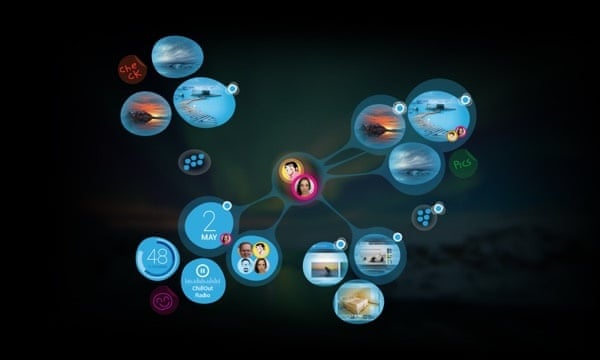 |
| Solu’s operating system uses the representation of nodes rather than linear lists of options. |
Solu's interface is striking. It totally shuns the scientific data design of Windows and OS X – where substance is orchestrated by record sort or capacity area – for something more visual. Joint effort spaces are introduced as a progression of air pocket like hubs associated together like neurons: messages, introductions, pictures and partners are altogether spoken to similarly in a similar space.
"There are no windows, no menu bars, no symbols. All that leaves. The UI is worked around cooperating in a web associated condition. Say farewell to the PC. This is altogether in light of coordinated effort," says Lawson.
Notwithstanding the abnormal interface there's an unordinary, Spotify-like plan of action. The client pays a settled month to month expense on top of the underlying price tag – around $20 (£13) a month – as an end-result of a boundless measure of capacity and access to applications. The membership income is then dispensed to designers of applications in light of utilization instead of irregular downloads.
Solu is soliciting a great deal from its clients. They have to get tied up with new equipment, new programming and another method for paying for and cooperating with substance. The interface individuals have developed to use throughout the most recent 30 years won't not be instinctive, but rather it is presently well-known. While it appears to be natural, almost no's comfortable about associating with Solu.
At the point when the gadget was exhibited in front of an audience at the dispatch occasion in San Francisco this week, it turned out to be certain that the innovation had getting teeth issues – credited unconvincingly to the setting's frail Wi-Fi. Head of plan Joona Kallio conceded after the dispatch introduction that a portion of the points of interest – including particular membership costs and battery life announcing – are as yet being tweaked ahead of time of the assessed sending date of May 2016.
Notwithstanding these difficulties, Lawson remains to a great degree bullish. He's says he's not hoping to be purchased by Google for $40m. "We need to incorporate it with a genuine organization with a plan of action."
He alluded to a forecast by investor Fred Wilson, who said that by 2020 the main three innovation organizations will be Facebook, Google and something else – not Apple, the biggest organization on the planet by market capitalisation. "We'd get a kick out of the chance to see ourselves in that main three," Lawson says.
Forrester innovation expert J P Gownder poured a little rain on the parade, bringing up that cell phones are ending up noticeably perpetually refined, and prevailing working frameworks, for example, Windows are advancing crosswise over gadgets.
"It's difficult to envision Solu taking off in a period when versatile working frameworks (iOS, Android) offer so much esteem, and when Windows 10 now keeps running over all shape variables. The odds of another biological system rising around this gadget appear to be thin," he said.
0 comentarios: